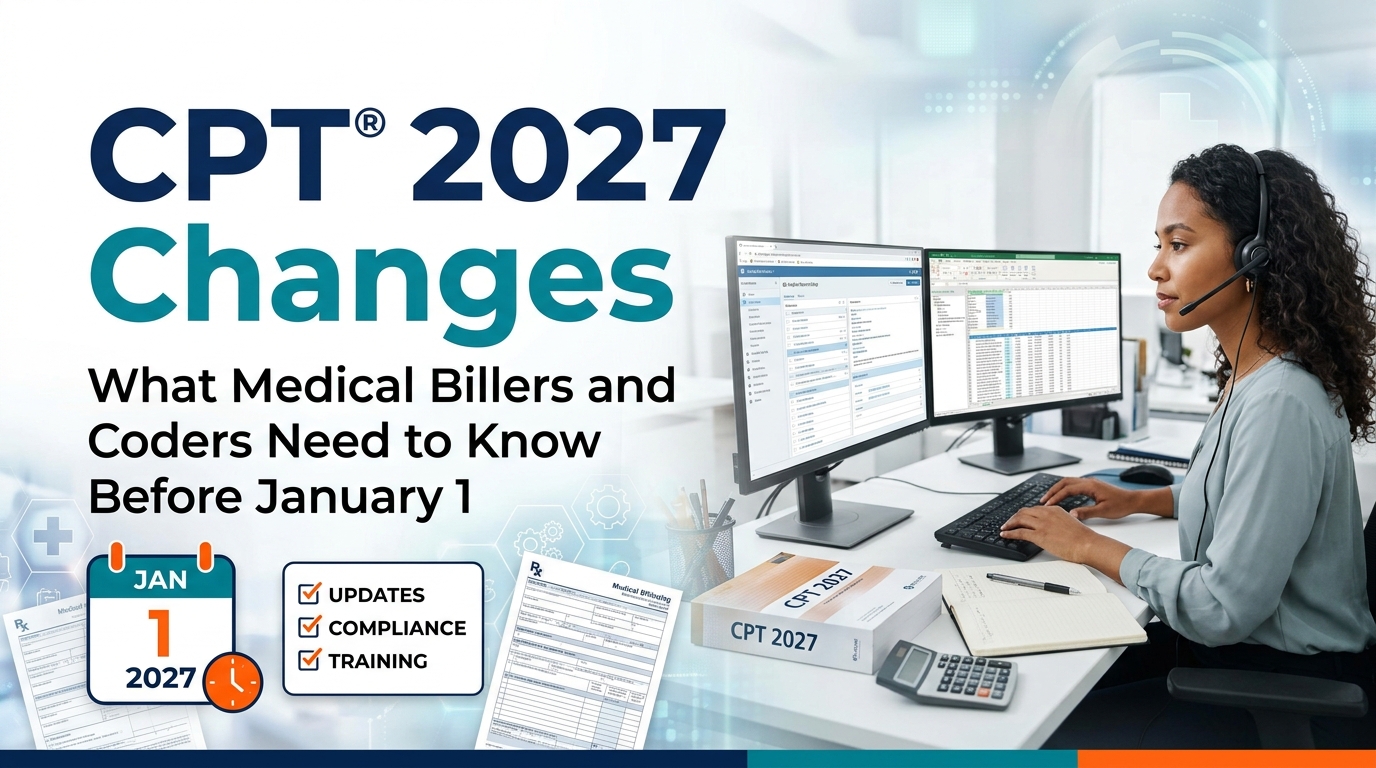
CPT 2027 Changes: What Medical Billers and Coders Need to Know Before January 1
CPT 2027 brings 299 new codes, a completely new way to report maternity care, 10 more AI codes and a Medicare pay cut, all from January 1. Here is what changes and a practical checklist for billing teams.
This article contains affiliate links. If you buy through them we may earn a commission at no extra cost to you. As an Amazon Associate I earn from qualifying purchases. Learn more.
The CPT 2027 code set takes effect on January 1, 2027, and it is one of the larger annual updates in recent years. It rewrites how maternity care is reported, adds more codes for AI-assisted services, and changes codes across gastroenterology, behavioral health, sleep medicine and radiology. At the same time, Medicare's 2027 physician fee schedule lowers the payment conversion factor.
If you run billing for a practice, the next few weeks decide whether January brings clean claims or a wave of denials. This guide summarizes what is changing and gives you a practical checklist to work through before go-live.
This article is a summary for planning purposes. Always code from the official 2027 CPT code set and your payers' current policies.
CPT 2027 at a glance
| Item | What to know |
|---|---|
| Effective date | Services provided on or after January 1, 2027 |
| Total editorial changes | 453, according to the AMA |
| New codes | 299 (including codes already released early during 2026) |
| Revised codes | 74 |
| Deleted codes | 80 |
| AI-related codes | 10 new, bringing the total to 43 |
| Biggest structural change | Global maternity care codes replaced by separate codes for each phase of care |
The headline figure of 299 new codes includes codes the AMA released early, such as many proprietary laboratory analysis (PLA) codes and some vaccine codes that are already in use. The number of brand-new codes switching on in January is smaller, but the changes that do arrive on January 1 affect some very high-volume services.
The biggest change: maternity care is no longer one global code
For decades, most obstetric care has been billed with a single global code covering the whole pregnancy: prenatal visits, delivery and postpartum care. From January 1, 2027, that bundle goes away. Maternity care is instead reported in four separate phases:
- Antepartum care – each prenatal visit is reported as its own evaluation and management (E/M) encounter, following normal E/M rules, with the place of service reflecting where the visit happened (office, hospital or telehealth).
- Labor management – reported once per calendar date, with separate codes for the initial and subsequent days, each split into straightforward and complex levels.
- Delivery – new, simpler codes for vaginal delivery (including VBAC) and cesarean delivery, covering the delivery itself. Labor management is billed separately. There are also new distinct codes for third- and fourth-degree laceration repair and for hysterectomy after cesarean delivery.
- Postpartum care – reported per encounter with E/M codes. Routine postpartum care on the day of delivery is included in the delivery code, and hospital days after a facility birth are billed with subsequent hospital care codes until discharge.
The AMA lists 17 deleted maternity codes, including the familiar global codes 59400, 59510 and 59610, along with 12 new codes and 6 revised ones.
Why it matters for billing: one claim per pregnancy becomes many claims per pregnancy. That affects charge capture, prior authorization, how you track patient balances, and how you measure revenue per delivery. Your practice management system, superbills and payer contracts all need to reflect the new structure. The AMA has published an FAQ that covers pregnancies that span the transition date. Read it carefully, because patients who are pregnant today will deliver under the new rules.
More codes for AI-assisted services
CPT 2027 adds 10 codes describing services where artificial intelligence supports or assists clinicians, bringing the total number of AI-related CPT codes to 43. The AMA says it has also refined its framework for AI services so it stays relevant as clinical AI evolves.
For billing teams, the practical point is that an AI tool being used during care does not automatically make a service billable. Check whether a specific code exists for the service, whether your payers cover it, and what documentation they expect before you add it to your charge master.
Other notable changes by specialty
- Gastroenterology: new codes for endoscopic submucosal dissection (ESD) of the upper and lower GI tract.
- Behavioral health: extensive revisions and additions to the adaptive behavior services section, covering assessments, treatment, family guidance and group services.
- Sleep medicine: significant changes to unattended (home) sleep testing codes. Professional groups advise sleep practices to review the September 2026 issue of CPT Assistant for the detail.
- Radiology: new and revised imaging codes, including a new table for head and neck MR angiography.
- Surgery and other areas: updates to hernia repair, prostate biopsy, ventricular assist device procedures and biofeedback.
- Pathology and laboratory: mostly PLA codes already in effect through early release, plus a small number of new genetic testing and biomarker codes that start on January 1.
Not every practice is affected by every change. Start by listing the codes your practice bills most often, then check each one against the 2027 additions, revisions and deletions.
Medicare pays less per RVU in 2027
CMS released the final 2027 Medicare Physician Fee Schedule on November 4, 2026. The key numbers:
| Conversion factor | 2026 | 2027 | Change |
|---|---|---|---|
| Most clinicians (not qualifying APM participants) | $33.40 | $32.63 | −2.31% |
| Qualifying participants in advanced APMs | $33.57 | $32.95 | −1.83% |
The main reason for the cut is the expiry of a temporary 2.5% payment increase that applied in 2026. The final cut for most clinicians is deeper than the one CMS proposed in July. Individual services can still go up or down depending on their relative value units, so update your expected-reimbursement tables code by code rather than applying a flat percentage. Our free Medicare RVU Payment Calculator shows the 2026 and 2027 payment for any code side by side.
A lower conversion factor makes every avoidable denial more expensive. If your clean claim rate slips during the transition, the combined effect on cash flow can be significant.
Your CPT 2027 go-live checklist
- Get the 2027 code books or data files for every coder and biller, and confirm your encoder software has loaded the 2027 update.
- Update your practice management and EHR systems. Ask your vendors when the 2027 code tables, edits and fee schedules will be installed, and test them before January 1.
- Rebuild superbills, order sets and templates that still list deleted codes, especially for maternity care.
- Load the 2027 Medicare fee schedule and any updated commercial payer fee schedules, then compare expected payments for your top 20 codes.
- Review payer policies. Check how your major payers will handle maternity care that started in 2026, new AI codes and any codes needing prior authorization.
- Train clinicians and coders on the maternity phases and the documentation each phase needs.
- Clear your 2026 backlog. Claims are coded using the codes valid on the date of service, so 2026 services should still be billed with 2026 codes, even if you submit them in January.
- Watch your metrics closely in January and February. Track denial rate, clean claim rate and days in A/R weekly rather than monthly, so problems surface early.
Our free calculators make that monitoring quick: use the Denial Rate Calculator, Clean Claim Rate Calculator and A/R Days Calculator. Compare January's numbers with your 2026 average, and investigate any jump straight away. For the bigger picture, see our guide to medical billing KPIs and revenue cycle metrics.
2027 reference books for your team
Make sure everyone who codes or audits claims has a current reference. Check that you are buying the 2027 edition:
- AMA CPT 2027 Professional Edition – the official code set and guidelines.
Check price on Amazon - CPT Changes 2027: An Insider's View – explains the reasoning behind each change, useful for training.
Check price on Amazon - HCPCS Level II 2027 – for supplies, drugs and equipment.
Check price on Amazon
Frequently asked questions
When do the CPT 2027 codes take effect?
For services provided on or after January 1, 2027. Some codes, such as early-release PLA and vaccine codes, were already effective during 2026 and are now published in the 2027 code set.
Can I still use deleted codes in 2027?
Not for services provided in 2027. Use the codes that were valid on the date of service. Do not assume a payer will accept deleted codes after January 1; check each payer's policy, especially for maternity care that started before the transition.
How many new CPT codes are there for 2027?
The AMA reports 299 new codes, 74 revisions and 80 deletions, for 453 editorial changes in total.
What happens to pregnancies that began in 2026?
This is one of the trickiest parts of the transition. The AMA has published specific guidance for care that spans the change, and payers may have their own rules. Review both before you bill any delivery in early 2027.
Bottom line
CPT 2027 is not a routine update. The maternity overhaul alone changes how obstetric revenue is captured, and the Medicare conversion factor cut leaves less margin for error. Practices that update their systems, train their teams and monitor claims closely in the first weeks of January will come through the transition with far fewer denials.
CPT is a registered trademark of the American Medical Association. This article is general information, not coding or legal advice.
Our articles are researched, fact-checked and reviewed by a human editor before publication. Spotted an error? Let us know. Read our editorial policy.