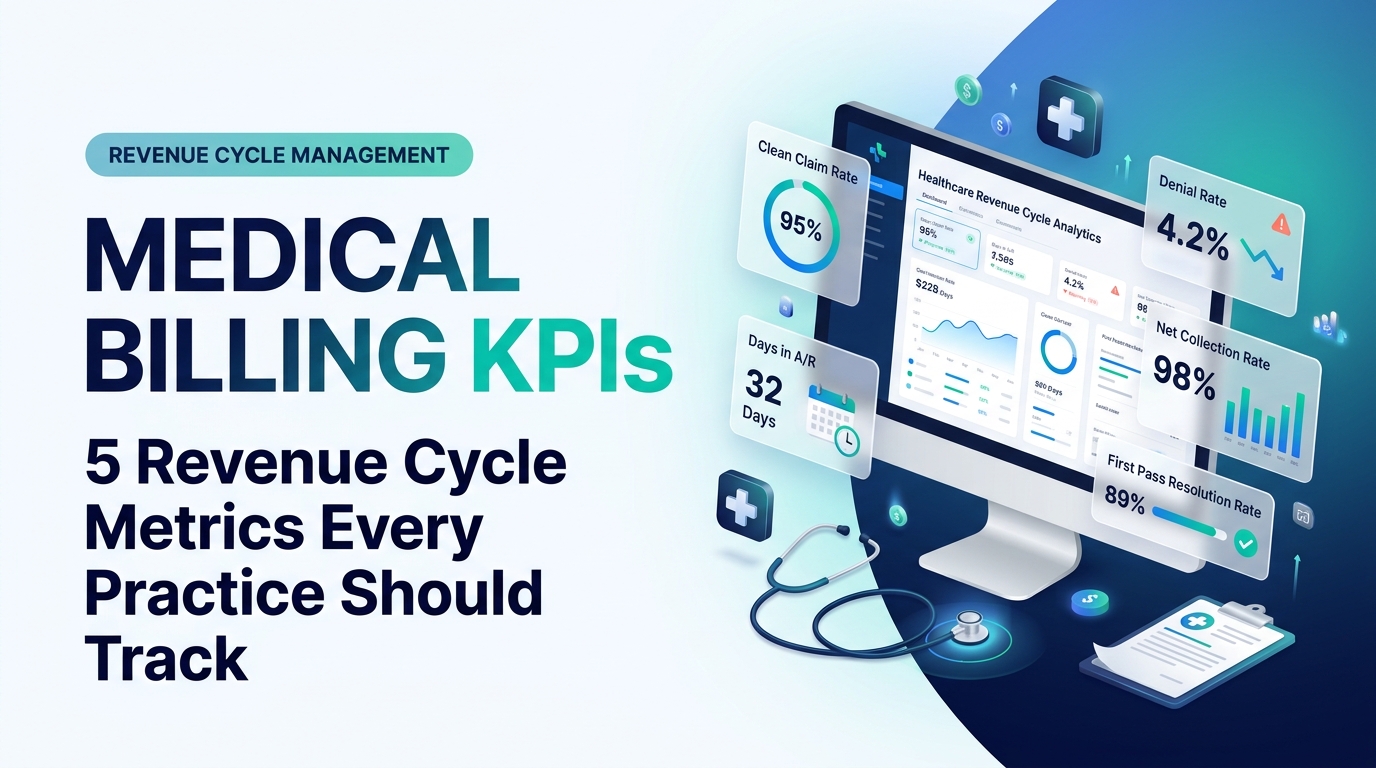
Medical Billing KPIs: 5 Revenue Cycle Metrics Every Practice Should Track
Denial rate, clean claim rate, first pass resolution, days in A/R and net collection rate – what each metric means, how to calculate it and what to do when it slips.
This article contains affiliate links. If you buy through them we may earn a commission at no extra cost to you. As an Amazon Associate I earn from qualifying purchases. Learn more.
Healthy cash flow in a medical practice depends on getting claims right the first time and collecting what you are owed quickly. The good news is that a handful of revenue cycle key performance indicators (KPIs) can tell you where money is leaking – often months before it shows up in the bank balance.
Below are five metrics that billing managers commonly track every month, with the formula for each and links to free calculators you can use straight away.
1. Denial rate
Your denial rate is the share of submitted claims that payers deny.
Denial rate = Claims denied ÷ Claims submitted × 100
Many organisations aim to keep their initial denial rate in the low single digits, but the right target depends on your specialty and payer mix. More important than the headline number is the reason for each denial. Group denials by cause – eligibility, missing authorisation, coding, documentation, timely filing – and fix the biggest category first.
Try the Denial Rate Calculator.
2. Clean claim rate
A clean claim passes clearinghouse and payer edits on first submission with no manual correction.
Clean claim rate = Clean claims ÷ Total claims submitted × 100
A commonly cited goal is 95% or higher. Low clean claim rates usually point to front-end problems: incomplete patient demographics, insurance details entered incorrectly, or coding edits that are not caught before submission.
Calculate yours with the Clean Claim Rate Calculator.
3. First pass resolution rate
First pass resolution rate (FPRR) measures claims that are paid or fully resolved on first submission.
FPRR = Claims resolved on first submission ÷ Total claims processed × 100
Every claim that needs follow-up costs staff time and delays payment. Tracking FPRR alongside denial rate shows whether process improvements are really reducing rework.
Use the First Pass Resolution Rate Calculator.
4. Days in accounts receivable
Days in A/R estimates how long, on average, it takes to collect payment.
A/R days = Total A/R ÷ (Gross charges for the period ÷ Days in the period)
Many practices aim for fewer than 40 days, though benchmarks vary. Use a consistent period – a trailing 90 days is common – so month-to-month changes reflect performance rather than seasonality. Also review the ageing of your A/R: a growing share of balances older than 90 days is a warning sign even if the average looks fine.
Work it out with the A/R Days Calculator.
5. Net collection rate
The net collection rate compares payments with what you are contractually allowed to collect.
Net collection rate = Payments ÷ (Charges − Contractual adjustments) × 100
Because it removes contractual adjustments, the net rate is a better measure of billing effectiveness than the gross rate. A net rate of around 95% or above is frequently cited as a strong result. Be careful to subtract only true contractual adjustments – not bad debt or denials that were written off.
See both gross and net figures with the Collection Rate Calculator.
Turning metrics into action
- Review monthly, investigate weekly. Look at trends every month, and dig into weekly data when a metric moves.
- Fix the front end. Eligibility checks, prior authorisation workflows and accurate registration prevent a large share of denials.
- Share results with the whole team. Front-desk, coding and billing staff all influence these numbers.
- Define metrics consistently. Write down exactly how you calculate each KPI so comparisons over time are meaningful.
2027 code books for your billing team
Coding accuracy drives most of the KPIs above, and outdated code books are a common cause of avoidable denials. The 2027 ICD-10-CM code set took effect on 1 October 2026, and the new CPT codes take effect on 1 January 2027, so now is the time to make sure every coder and biller has current references.
- AMA CPT 2027 Professional Edition – the official CPT code set and guidelines.
Check price on Amazon - CPT Changes 2027: An Insider’s View – explains why each code changed; helpful for training.
Check price on Amazon - ICD-10-CM 2027 – available from several publishers; choose the edition your team is used to.
Compare on Amazon - HCPCS Level II 2027 – for supplies, drugs and durable medical equipment.
Check price on Amazon
Check that you are buying the 2027 edition, and confirm the current price on Amazon before ordering.
Our articles are researched, fact-checked and reviewed by a human editor before publication. Spotted an error? Let us know. Read our editorial policy.