Profit Margin vs Markup: What’s the Difference and Why It Matters
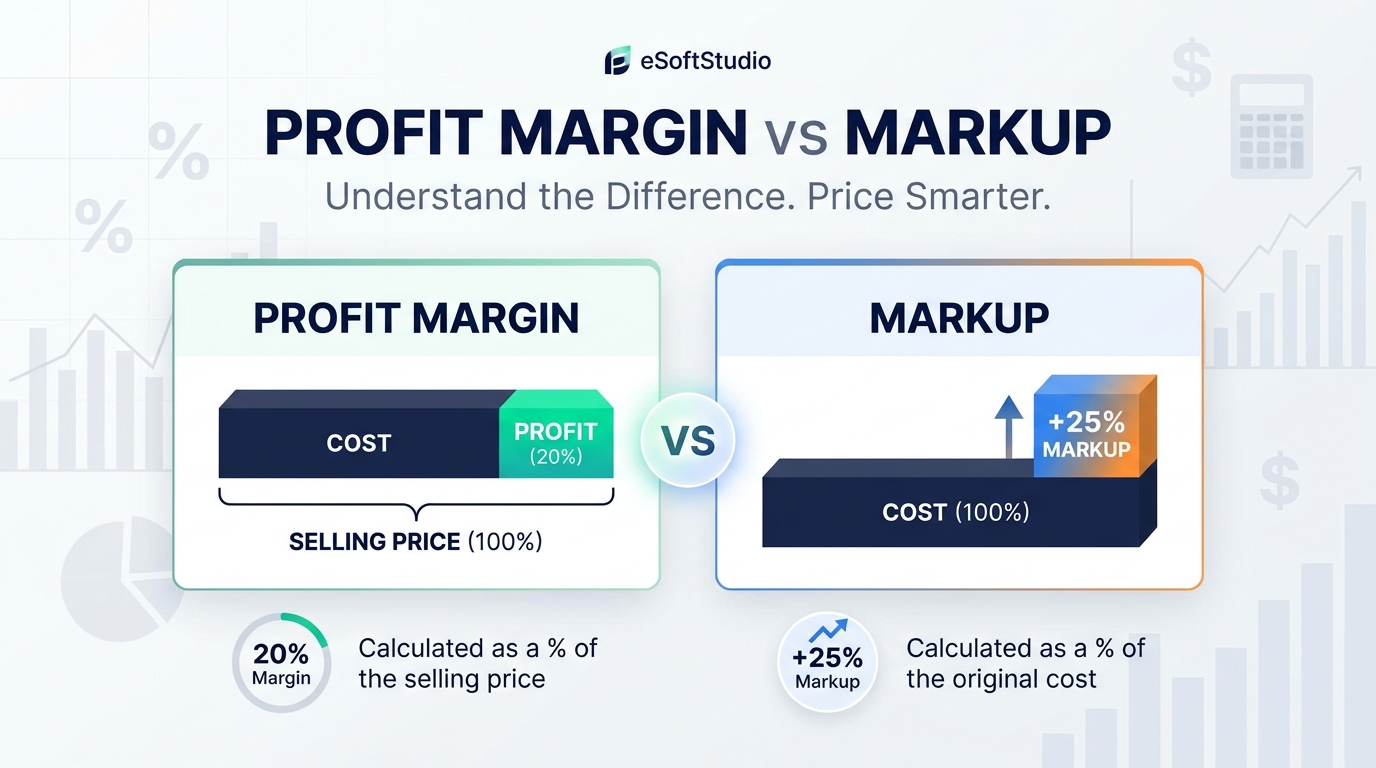
Margin and markup describe the same profit from two angles. Mixing them up is one of the most common – and expensive – pricing mistakes small businesses make.
Imagine you want a 40% profit margin, so you add 40% to your costs. A product that costs $100 is priced at $140. Your profit is $40 – but your margin is only 28.6%, not 40%. That gap between markup and margin can quietly erode profits across an entire product range.
The definitions
Both numbers start with the same gross profit: selling price minus cost. They differ in what you divide by.
- Markup is profit as a percentage of cost:
(Price − Cost) ÷ Cost × 100 - Profit margin is profit as a percentage of price:
(Price − Cost) ÷ Price × 100
Because price is always larger than cost (when you make a profit), the margin is always the smaller of the two numbers.
A worked example
You buy a product for $60 and sell it for $100.
- Gross profit: $100 − $60 = $40
- Markup: $40 ÷ $60 = 66.7%
- Margin: $40 ÷ $100 = 40%
Same sale, same $40 – two very different percentages. Check your own numbers with the Profit Margin Calculator or the Markup Calculator.
Converting between markup and margin
| Markup | Equivalent margin |
|---|---|
| 25% | 20% |
| 33.3% | 25% |
| 50% | 33.3% |
| 66.7% | 40% |
| 100% | 50% |
The formulas are:
Margin = Markup ÷ (1 + Markup)Markup = Margin ÷ (1 − Margin)
Pricing for a target margin
If you know the margin you need, don’t add it to cost. Instead divide cost by one minus the margin:
Price = Cost ÷ (1 − Target margin)
To achieve a 40% margin on a $60 product: $60 ÷ 0.6 = $100.
Which should you use?
Use whichever your team understands – but be consistent and label it clearly. Many retailers think in markup when setting prices, while accountants and investors usually talk about margin because it relates directly to revenue on a profit and loss statement.
Gross margin is not the whole story
The examples above are gross margin: they only subtract the direct cost of the product. Your business also has overheads – rent, salaries, software, marketing – so net profit margin will be lower. To see how many sales you need to cover those fixed costs, use our Break-Even Calculator.
Our articles are researched, fact-checked and reviewed by a human editor before publication. Spotted an error? Let us know. Read our editorial policy.