Break-Even Analysis Explained: A Step-by-Step Guide for Small Businesses
How many sales do you need to cover your costs? Learn the break-even formula, work through an example and use the result to test prices and plans.
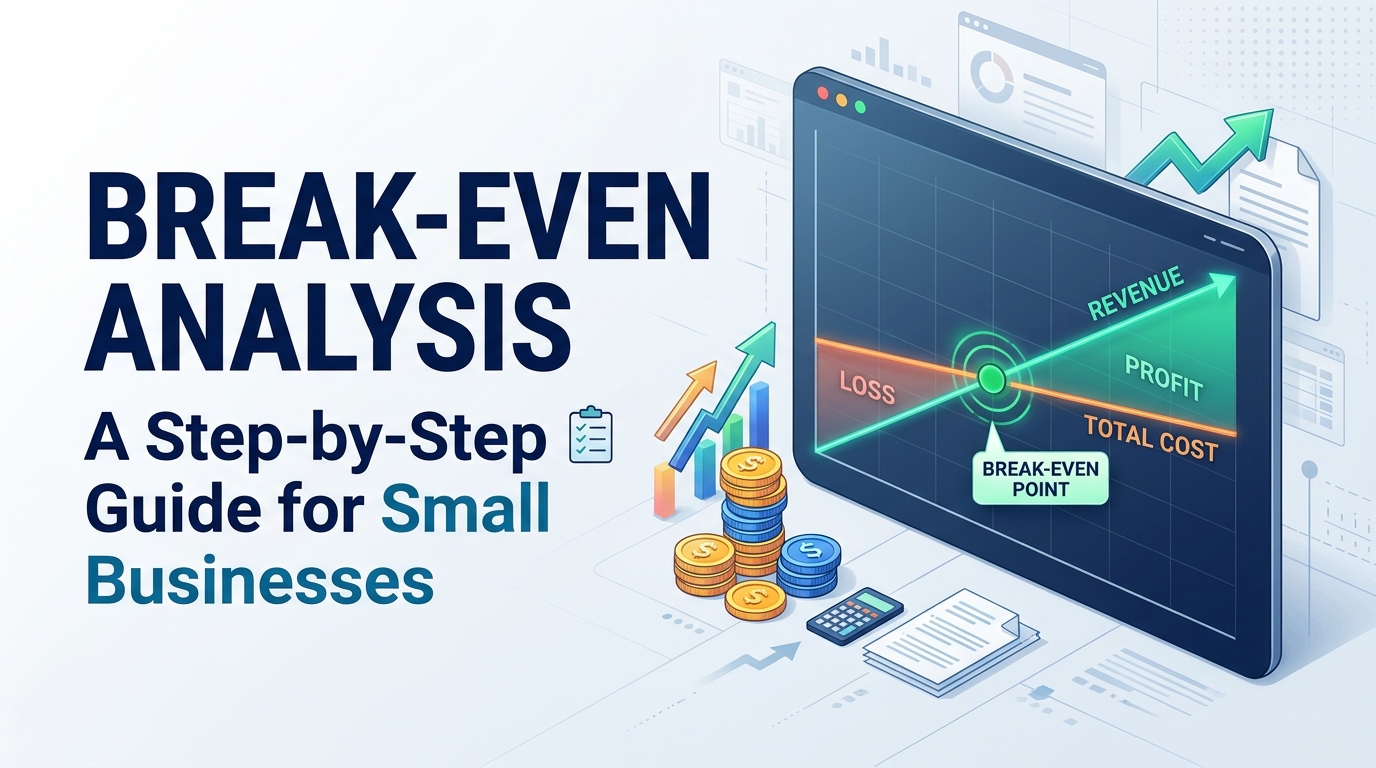
Your break-even point is the level of sales at which total revenue equals total costs – no profit, no loss. Knowing it helps you set realistic prices and sales targets, and decide whether a new product or expense makes sense.
Step 1: Separate fixed and variable costs
- Fixed costs stay the same regardless of how much you sell in the short term: rent, salaries, insurance, software subscriptions.
- Variable costs rise with each sale: materials, packaging, payment processing fees, shipping, sales commissions.
Some costs are a mix (for example, a phone plan with a fixed fee plus usage). Split them as best you can – the analysis doesn’t need to be perfect to be useful.
Step 2: Calculate your contribution margin
Contribution margin is what each sale contributes towards fixed costs after covering its own variable costs:
Contribution margin per unit = Price − Variable cost per unit
Step 3: Find the break-even point
Break-even units = Fixed costs ÷ Contribution margin per unit
Break-even revenue = Break-even units × Price
A worked example
A small online shop has fixed costs of $12,000 a month. It sells a product for $50 with variable costs of $20 per unit.
- Contribution margin: $50 − $20 = $30
- Break-even units: $12,000 ÷ $30 = 400 units per month
- Break-even revenue: 400 × $50 = $20,000
To earn a $6,000 monthly profit, add the target to fixed costs: ($12,000 + $6,000) ÷ $30 = 600 units.
Run your own numbers in the Break-Even Calculator.
Using break-even to make decisions
- Testing prices: raising the price to $55 lifts the contribution margin to $35 and cuts break-even to about 343 units. Will you lose fewer than 57 sales?
- Evaluating new costs: a $1,500/month tool adds 50 units to break-even at a $30 contribution margin. Will it generate that much extra?
- Checking feasibility: if break-even is far above what you can realistically sell, rethink the plan before you invest.
Limitations
Break-even analysis assumes a constant price and variable cost per unit, and that you sell everything you produce. Real businesses offer discounts, sell multiple products and face changing costs. Treat the result as a planning guide, revisit it regularly, and pair it with cash flow forecasts. For pricing, see our guide to profit margin vs markup.
Our articles are researched, fact-checked and reviewed by a human editor before publication. Spotted an error? Let us know. Read our editorial policy.